
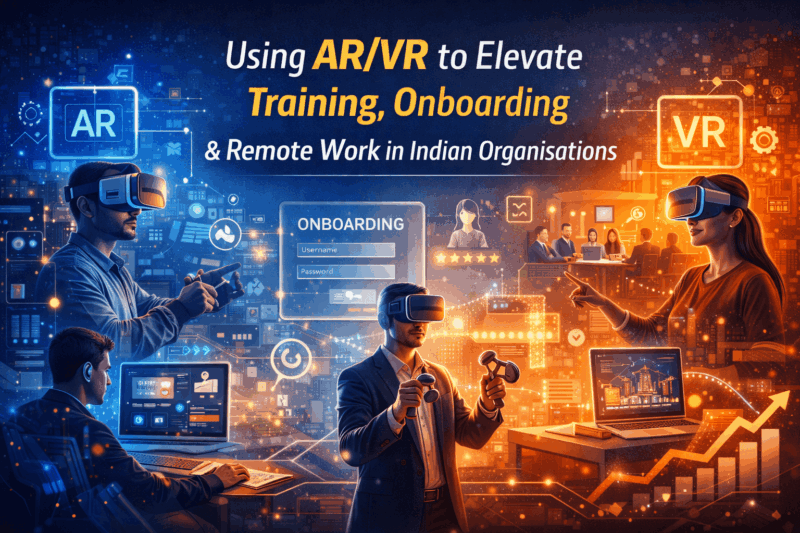
Imagine this.
Your new employee walks into the office on Day 1…
But instead of thick manuals and endless slides, they wear a headset.
Within minutes, they are:
- Touring the factory floor
- Practicing real-life scenarios
- Interacting with virtual machines
- Learning processes hands-on
No risk.
No confusion.
No boredom.
Just immersive learning.
That’s not science fiction anymore.
That’s AR/VR-powered training — and it’s quietly transforming how Indian organisations train, onboard, and collaborate remotely.
By 2026, companies that adopt immersive technologies will outperform competitors in productivity, retention, and efficiency.
The question is not “Should we adopt AR/VR?”
It’s “How fast can we integrate it into our digital ecosystem?”
Let’s break it down.
What Are AR & VR in Simple Terms?
Before diving deep, let’s simplify.
AR (Augmented Reality)
→ Adds digital elements to the real world
Example: Mobile app showing equipment instructions over live camera
VR (Virtual Reality)
→ Fully immersive digital environment
Example: Virtual factory or office training simulation
Together, they create experiential learning, which is far more effective than traditional training methods.
Because people remember:
- 10% of what they read
- 20% of what they hear
- 90% of what they experience
And AR/VR is all about experience.
Why Indian Organisations Need Immersive Training Now
India’s workplace is changing fast:
- Hybrid work is normal
- Remote teams are growing
- Skill gaps are increasing
- Onboarding needs to be faster
- Physical training costs are rising
Traditional approaches struggle because:
❌ Classroom training is slow
❌ Travel is expensive
❌ Slides are boring
❌ Manuals are ignored
❌ Remote onboarding feels disconnected
AR/VR solves all of this.
It brings real-world simulation without real-world risk.
Use-Case 1: Smarter Employee Training
Imagine training factory workers or technicians without touching real equipment.
With VR simulations, they can:
✔ Practice machine handling
✔ Learn safety protocols
✔ Troubleshoot problems
✔ Repeat tasks multiple times
✔ Make mistakes safely
Industries like:
- Manufacturing
- Healthcare
- Logistics
- Construction
- IT support
benefit massively from hands-on virtual learning.
This reduces:
- Training time
- Accidents
- Errors
- Costs
And improves confidence dramatically.
Use-Case 2: Faster & Engaging Onboarding
Most onboarding looks like this:
Forms → presentations → PDFs → confusion.
Now compare it with:
Virtual office tours
Interactive workflows
Scenario-based learning
Role simulations
New hires feel involved immediately.
They understand:
- Company processes
- Tools
- Systems
- Culture
Even before physically meeting teams.
But here’s the key:
AR/VR tools need strong digital platforms to integrate properly.
That’s where robust Web Development Services help create scalable portals and systems to host training dashboards, LMS platforms, and immersive content.
Use-Case 3: Remote Collaboration That Feels Real
Remote meetings often feel:
- Passive
- Distracting
- Unproductive
With VR collaboration spaces:
Teams can:
✔ Meet in virtual rooms
✔ Work on shared 3D models
✔ Conduct live demos
✔ Brainstorm visually
It feels closer to being physically present.
For distributed teams across India, this reduces travel costs and improves communication.
Why Digital Infrastructure Matters Before AR/VR
Here’s a mistake many organisations make:
They invest in fancy AR/VR tools…
But ignore digital foundations.
Without:
- Fast websites
- Stable systems
- Centralized dashboards
- Secure infrastructure
Even the best tech fails.
That’s why businesses must first build:
👉 Scalable platforms
👉 Structured systems
👉 Content control
Solutions like CMS Development help manage:
- Training materials
- Knowledge bases
- Course updates
- Interactive content
All in one place.
Because immersive tech still needs strong backend support.
Don’t Forget Visibility & Adoption
Even the best training platform is useless if employees don’t use it.
Internal marketing and communication matter.
Smart SEO & SMO strategies help organisations:
✔ Share knowledge content
✔ Improve discoverability
✔ Increase platform usage
✔ Educate employees digitally
And for campaigns or launches, SEM & SMM initiatives can drive quick adoption across teams and partners.
Because technology succeeds only when people embrace it.
AR/VR + E-commerce + Service Platforms
AR/VR isn’t just for internal teams.
External use cases include:
- Virtual product demos
- 3D product previews
- Interactive showrooms
- Remote consulting
Companies offering products or services online can integrate these features within their E-commerce Development platforms.
Imagine customers virtually testing products before purchase.
That’s next-level experience.
And it increases conversions dramatically.
Maintenance: The Hidden Hero
Immersive systems require continuous updates:
- Security patches
- Performance improvements
- Content refresh
- Compatibility fixes
Without ongoing care, systems break.
Reliable Website Maintenance Services ensure:
✔ Smooth performance
✔ Safe operations
✔ Better uptime
✔ Consistent experience
Because downtime during training kills productivity.
The Skill Gap Challenge
Here’s another reality:
AR/VR tools need skilled professionals.
Developers.
Designers.
Content creators.
Tech operators.
Indian organisations must invest in talent.
Programs like:
help build job-ready tech talent who can manage emerging technologies confidently.
Because tools don’t transform businesses.
People do.
ROI of AR/VR Adoption
Let’s talk numbers.
Organisations adopting immersive training report:
✔ 40–60% faster learning
✔ 30–50% lower training costs
✔ Better retention
✔ Fewer operational errors
✔ Higher employee engagement
✔ Reduced travel expenses
The ROI isn’t just financial.
It’s cultural.
Employees feel modern, empowered, and future-ready.
A Simple Roadmap to Start
Not sure how to begin?
Start small:
Step 1 → Build strong web infrastructure
Step 2 → Create centralized CMS
Step 3 → Launch pilot AR/VR training module
Step 4 → Gather feedback
Step 5 → Scale gradually
Step 6 → Maintain consistently
Avoid overcomplicating.
Start practical.
How Devexis India Helps
At Devexis India, we believe immersive technology works best when backed by solid digital ecosystems.
We help organisations with:
✔ Web Development
✔ CMS Systems
✔ E-commerce Platforms
✔ SEO & Digital Marketing
✔ SEM/SMM
✔ Website Maintenance
✔ Skill Development & Training
So your AR/VR initiatives don’t stand alone — they integrate seamlessly into your growth strategy.
The future workplace isn’t just remote.
It’s immersive.
Training won’t be passive.
Onboarding won’t be boring.
Collaboration won’t feel distant.
AR/VR is not a luxury anymore.
It’s becoming a competitive advantage.
Indian organisations that adopt early will:
- train faster
- perform better
- retain talent
- scale smarter
If you’re ready to build future-ready digital platforms that support immersive technologies, Devexis India is here to help you design, develop, and scale with confidence.
Because learning shouldn’t just inform.
It should transform.