
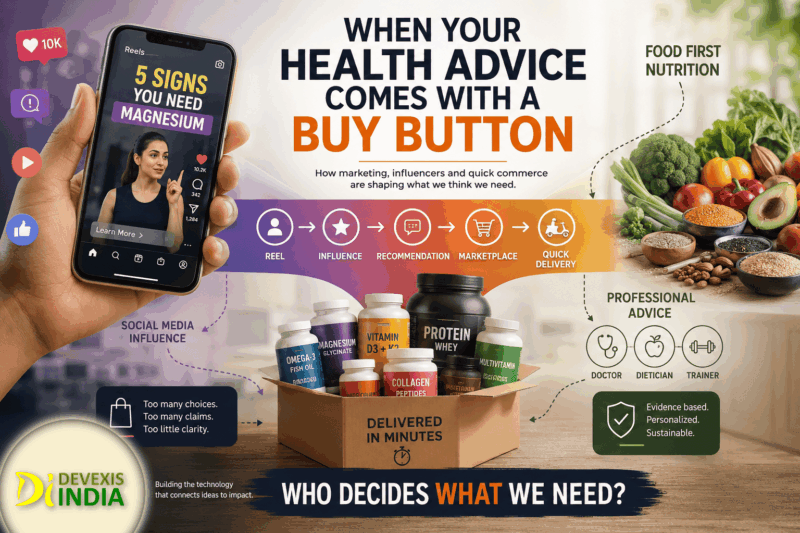
How social media, supplement brands, professionals, marketplaces and quick commerce are creating a new health economy — and where technology can make it more trustworthy
By Devexis India
There was a time when the answer to the question “What should I take for better health?” was largely answered with another question:
“What are you eating?”
Today, the answer increasingly comes in the form of a product.
Magnesium.
Vitamin D3.
K2.
Zinc.
Omega-3.
Collagen.
Probiotics.
Multivitamins.
Electrolytes.
Protein.
Sleep supplements.
Joint supplements.
Hair supplements.
Skin supplements.
And increasingly, there isn’t just one product.
There are dozens of brands, formulations, combinations, dosages and delivery options — available through pharmacies, Amazon, Flipkart, brand websites and increasingly through quick-commerce platforms.
Some products arrive in a few days.
Others can arrive in minutes.
The nutrients themselves are not new.
The ecosystem around them is.
India’s health supplement and nutraceutical sector is expanding rapidly, although market-size estimates vary considerably depending on how the category is defined. What is less debatable is the direction: more brands, more products, more digital discovery, more professional and influencer involvement, and more channels through which consumers can purchase supplements.
At the same time, India has an established regulatory framework for health supplements and nutraceuticals through the Food Safety and Standards Authority of India (FSSAI).
So this isn’t simply a story about whether supplements are “good” or “bad.”
It is a story about something much bigger:
How an entire industry is being built around deciding what people believe they need to consume for their health.
The Nutrients Were Always There
Magnesium did not arrive with magnesium glycinate.
Vitamin D did not arrive with D3 capsules.
Calcium did not begin existing when calcium tablets appeared.
Collagen was present in the human body long before collagen powders became a consumer category.
For generations, nutrients came primarily through food.
Pulses, grains, vegetables, fruits, nuts, seeds, dairy and other foods supplied combinations of protein, vitamins, minerals, fats, fibre and other compounds.
That doesn’t mean supplementation is unnecessary.
It isn’t.
There are legitimate situations where supplementation can be useful or important — including documented deficiencies, inadequate dietary intake, increased nutritional requirements and circumstances in which obtaining sufficient amounts from food is difficult.
The problem begins when we move from:
“Supplement a genuine nutritional gap.”
to:
“Everyone needs a supplement stack.”
Those are two very different ideas.
And somewhere between nutrition science and consumer marketing, the distinction is becoming increasingly difficult for ordinary consumers to see.
From Nutrition to Product
The modern supplement economy has created an interesting transformation.
The original question was:
What does my body need?
The commercial question became:
Which product should I buy?
And now the digital question is increasingly:
Which product does the algorithm think I should buy?
This is a significant change.
A nutrient can become a product category.
A product category can become a content category.
A content category can become an influencer category.
An influencer category can become a business.
And that business can ultimately become a direct-to-consumer sales channel.
The consumer journey can therefore look something like:
Reel → curiosity → research → recommendation → marketplace → purchase → repeat purchase
The entire journey can happen without a consumer ever visiting a doctor’s office.
The New Supplement Funnel
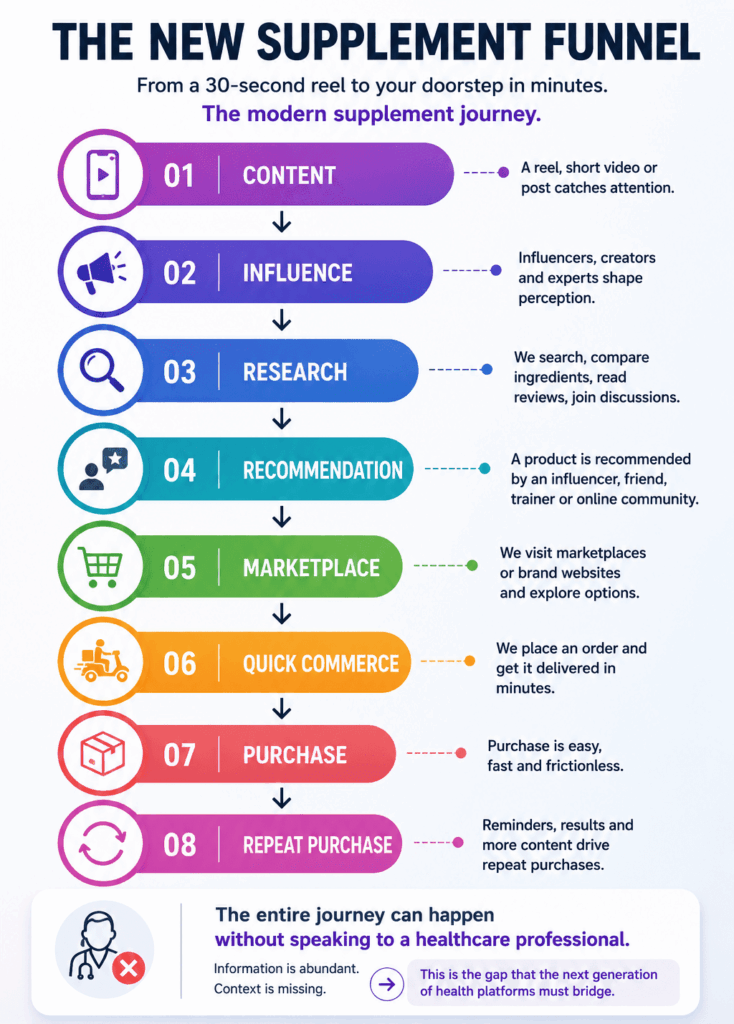
The modern supplement journey can move through several stages:
CONTENT
A reel, short video, post or article catches attention.
↓
INFLUENCE
An influencer, creator, trainer, friend or online community shapes perception.
↓
RESEARCH
The consumer searches, compares ingredients, reads reviews and looks for explanations.
↓
RECOMMENDATION
Someone — professional or otherwise — suggests a particular nutrient, formulation or brand.
↓
MARKETPLACE
The consumer compares products and prices.
↓
QUICK COMMERCE
The product can potentially reach the consumer extremely quickly.
↓
PURCHASE
↓
REPEAT PURCHASE
This is more than a retail funnel.
It is increasingly becoming an information funnel.
And that distinction matters.
The New Health Educator May Be a 30-Second Reel
Perhaps the biggest change is not the supplement itself.
It is who is educating consumers about supplements.
Social media has made health information extraordinarily accessible.
That is, in many ways, a positive development.
People can discover nutrition concepts, exercise information, general wellness guidance and new research from experts and educators who previously had limited reach.
But the same system creates a difficult question:
Where does education end and advertising begin?
A creator might begin with:
“Five signs you may be deficient in magnesium.”
The next video explains different forms of magnesium.
The next recommends a particular formulation.
The next includes a product link.
The consumer has moved from education to commerce in minutes.
There is nothing inherently wrong with selling a product after educating a consumer.
But health information deserves a high standard of transparency because commercial incentives can influence which information receives attention.
And the boundary becomes even more interesting when influencers move from recommending products to creating their own consumer brands.
The person holding the audience can increasingly become the person owning the product.
That changes the economics of health education.
When Every Problem Gets a Supplement
Modern supplement marketing has another powerful characteristic:
Almost everything can become a product category.
Want better sleep?
There is a supplement.
Want healthier skin?
There is a supplement.
Want stronger hair?
There is a supplement.
Want better joints?
There is a supplement.
Want immunity support?
There is a supplement.
Want energy?
There is a supplement.
Want gut health?
There is a supplement.
Want recovery?
There is a supplement.
Want to support your bones?
There is a supplement.
And sometimes there are dozens.
This creates a new consumer psychology.
Instead of asking:
“What behaviour should I change?”
people can increasingly ask:
“Which capsule should I add?”
But human health is rarely that simple.
Poor sleep may involve sleep habits, stress, caffeine, exercise, environment or an underlying condition.
Poor nutrition may involve the overall diet.
Low energy can have many possible explanations.
Joint discomfort may require evaluation rather than a shopping recommendation.
The existence of a supplement for a problem does not automatically establish that the supplement is the solution.
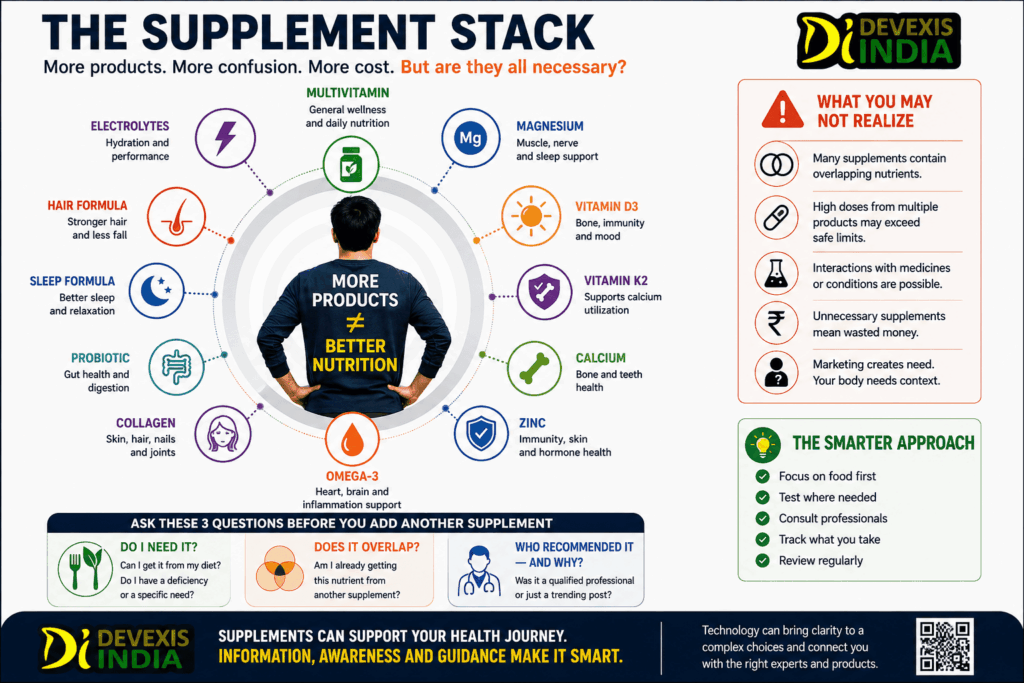
The Supplement Stack
This is where the modern supplement economy becomes particularly interesting.
One product becomes two.
Two become five.
Five become ten.
A consumer may begin with a multivitamin.
Then add magnesium.
Then D3.
Then K2.
Then calcium.
Then omega-3.
Then collagen.
Then a probiotic.
Then a sleep formula.
Then a hair formula.
Individually, many of these products may appear reasonable.
The problem is the combined picture.
Are the nutrients duplicated?
Is the total intake appropriate?
Does the consumer actually need all of them?
Are several products addressing the same objective?
Could some products interact with medicines or existing conditions?
Is the consumer paying repeatedly for products that overlap?
These are not simple shopping questions.
They are information and decision-making questions.
The Marketplace Has Solved Availability
Amazon, Flipkart and other e-commerce platforms solved an important problem:
Availability.
Consumers can discover products from hundreds of brands, compare prices, read reviews and order from home.
Quick commerce is solving another problem:
Speed.
But neither automatically solves the most important problem:
Decision quality.
A marketplace can tell you:
- price
- rating
- reviews
- ingredients
- seller
- delivery time
But the consumer’s real question is often:
“Is this actually appropriate for me?”
That is much harder to answer.
A marketplace can tell you what is available.
It cannot, by itself, establish what you personally need.
Quick Commerce Changes the Psychology
E-commerce made supplements easy to purchase.
Quick commerce makes them frictionless.
Traditional purchase:
Need → search → compare → order → wait
Quick-commerce purchase:
Need → search → order → doorstep
India’s quick-commerce ecosystem has expanded significantly beyond its original grocery proposition, and health and wellness products are increasingly part of this wider assortment.
Major platforms now expose consumers to categories such as vitamins, minerals, protein products, fish oil, electrolytes and other wellness products alongside everyday consumer goods.
That matters psychologically.
When a consumer can order a supplement alongside milk, fruits and household products and receive it rapidly, the supplement begins to feel less like a considered health purchase and more like an everyday consumer product.
Quick commerce does not necessarily create nutritional demand.
It removes friction from acting on nutritional demand.
That is a subtle but important difference.
The Doctor Is No Longer Necessarily the First Point of Discovery
Healthcare has traditionally operated around professional gatekeepers.
A doctor evaluates a patient.
A dietician evaluates nutrition.
A trainer evaluates fitness.
A pharmacist advises on products.
The consumer then acts.
The internet has changed this journey.
Today, a consumer can discover a supplement before speaking to any professional.
They can:
- watch videos
- read reviews
- compare brands
- search scientific terminology
- ask online communities
- consult AI tools
- browse marketplaces
- order the product
By the time they meet a professional, they may already have a strong belief about what they need.
This does not make doctors, dieticians or other qualified professionals less important.
It makes their role potentially more important.
The opportunity is to bring professional expertise into the digital journey rather than expecting consumers to leave the digital journey behind.
Regulation Matters — But Regulation Isn’t Personalization
India is not operating in a regulatory vacuum.
FSSAI has a dedicated regulatory framework covering health supplements and nutraceuticals, along with related categories such as foods for special dietary use, functional foods, probiotics and prebiotics.
The regulations also place requirements and restrictions around product claims and labelling.
This distinction is important.
A product being legally marketed does not automatically mean:
you need it.
A product meeting applicable regulatory requirements does not mean:
it is the best choice for you.
And a product having thousands of positive reviews does not mean:
it is appropriate for you.
Regulation establishes important boundaries.
But personalization requires context.
Information Without Context Creates a New Problem
We now have more health information than ever.
But information and understanding are not the same thing.
A consumer may know:
“Magnesium is important.”
But that does not necessarily answer:
“Do I need additional magnesium?”
They may know:
“Vitamin D is important.”
But that does not answer:
“Do I need supplementation, and if so, how much and for how long?”
They may know:
“Collagen is associated with connective tissue.”
But that does not automatically answer:
“Will this particular collagen product provide a meaningful benefit for my specific goal?”
The gap between information and decision-making is where the next generation of digital health platforms could play an important role.
The Real Opportunity: Build the Layer Between Information and Commerce
The obvious startup idea is:
Launch another supplement brand.
There is nothing wrong with that model.
But it is already a crowded market.
A potentially larger opportunity is:
Build the technology layer that makes supplement discovery, recommendation and purchasing more intelligent and trustworthy.
Imagine a platform where a consumer can see their complete supplement profile.
Not just what they want to buy.
But:
- what they are already taking
- what has been recommended
- which ingredients overlap
- what requires professional confirmation
- what products are available
- what information supports a particular recommendation
- when a recommendation should be reviewed
The platform does not need to become the doctor.
It needs to make the relationship between consumer, professional and commerce more intelligent.
Imagine a Connected Supplement Ecosystem
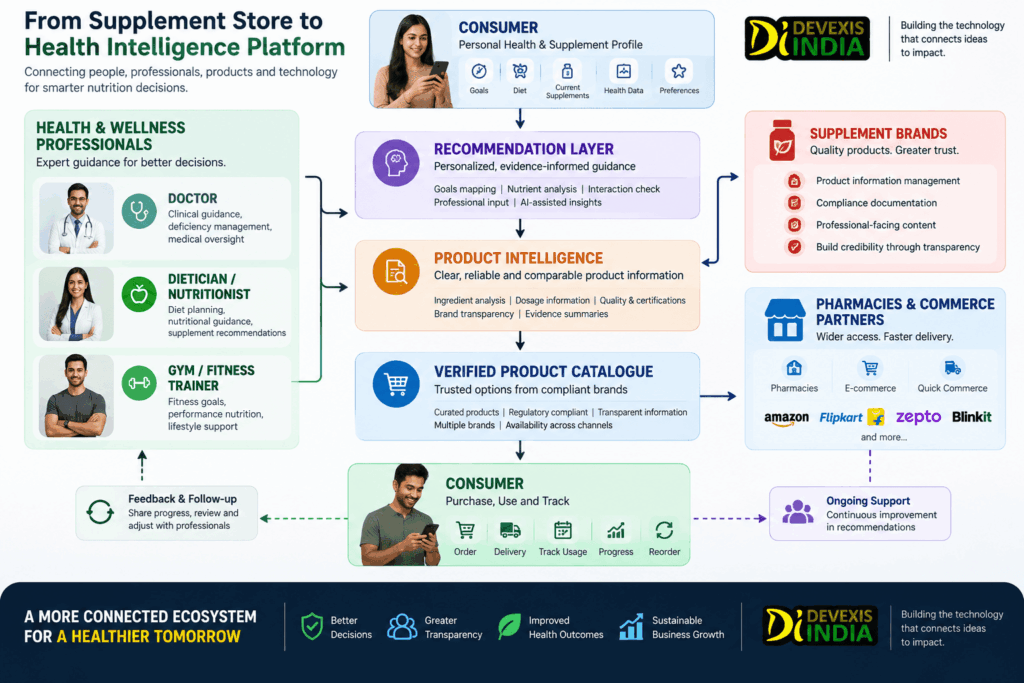
Imagine the ecosystem as a connected platform.
Consumer
The consumer maintains a personal profile containing relevant goals, dietary preferences, current supplements and other information they choose to provide.
Doctor
A doctor can provide clinical guidance where appropriate and record recommendations in a structured digital workflow.
Dietician / Nutritionist
A nutrition professional can connect dietary planning with supplementation recommendations.
Fitness Professional
A trainer can manage fitness and performance-related recommendations within appropriate professional boundaries.
Supplement Brand
Brands can provide structured product information, quality documentation and transparent formulation details.
Product Intelligence
The platform can organize ingredient information, dosage information, product attributes, certifications and evidence summaries.
Verified Catalogue
Consumers can discover products from participating brands through a more structured catalogue.
Commerce
Orders can potentially be fulfilled through pharmacies, e-commerce and quick-commerce partners.
Feedback
Usage, adherence and progress can feed back into the professional relationship.
The result is not simply an online supplement shop.
It is a connected health-commerce ecosystem.
For Consumers: Understand What You Are Taking
A consumer-facing platform could provide a Personal Supplement Profile.
Instead of remembering ten different bottles, the consumer could see everything in one place:
Currently taking
Professionally recommended
Potentially overlapping
Requires review
Available alternatives
The objective would not be:
“Buy more.”
It would be:
“Understand what you’re taking.”
That distinction could become the foundation of trust.
For Doctors: Bring Recommendations Into the Digital Workflow
A doctor could potentially use a professional dashboard to:
- record supplement recommendations
- specify duration
- review existing supplement use
- identify potential duplication
- monitor adherence
- update recommendations
- maintain a history of professional guidance
The important point is not to turn doctors into online supplement sellers.
It is to give professionals better digital tools for a process that is already happening.
The consumer is already online.
The question is whether professional expertise will be part of that journey.
For Dieticians and Nutritionists
Dieticians and nutritionists could connect dietary plans with structured supplementation workflows.
Instead of sending a recommendation through a PDF, WhatsApp message or handwritten note, the professional could create a digital protocol.
The consumer could then see:
What to take
Why it was recommended
How it fits into the overall plan
For how long
When it should be reviewed
This creates continuity between advice and action.
For Gyms and Fitness Professionals
Fitness professionals already influence supplement decisions.
Protein, hydration, recovery and performance products are naturally discussed in fitness environments.
A technology platform could provide gyms and trainers with structured tools for managing appropriate wellness recommendations while maintaining an important boundary:
Fitness guidance should remain fitness guidance.
Medical decisions should remain with appropriately qualified healthcare professionals.
Technology should reinforce this distinction, not blur it.
For Supplement Brands
Brands also stand to benefit from a more structured ecosystem.
Instead of competing primarily on:
Influencer reach + discount + advertising
brands could compete on:
- product quality
- transparency
- formulation
- documentation
- evidence
- professional acceptance
- manufacturing standards
- customer experience
This could create a healthier competitive environment.
Responsible brands would have something valuable to gain from being transparent.
For Pharmacies and Commerce Platforms
The commerce layer does not disappear.
It becomes smarter.
A professional recommendation could connect to a relevant product catalogue.
A consumer could compare appropriate options.
A pharmacy, e-commerce platform or quick-commerce provider could fulfil the order.
The marketplace still makes the transaction.
But the decision layer becomes more intelligent.
The Business Model Could Be B2B2C
This ecosystem can potentially support several business models simultaneously.
Consumers
Personalized supplement management and discovery.
Doctors
Professional recommendation and monitoring tools.
Dieticians
Nutrition planning and supplement management.
Fitness Businesses
Member wellness and recommendation workflows.
Brands
Product information management and professional distribution.
Pharmacies
Digital demand and fulfilment.
Commerce Platforms
Structured health-product discovery.
This creates a potential B2B2C technology platform rather than simply another D2C supplement company.
But There Is One Rule That Cannot Be Compromised
Trust Must Remain Independent of Commerce
If a platform claims to provide health guidance but simply promotes whichever brand pays the most, it recreates the very problem it was designed to solve.
Any credible platform therefore needs clear separation between:
Professional recommendation
Scientific evidence
Commercial availability
Sponsored placement
Affiliate relationships
Consumer choice
If a brand has paid for visibility, consumers should know.
If a professional has a commercial relationship with a brand, that relationship should be transparent.
If a product is surfaced because of commercial placement rather than professional or evidence-based criteria, that distinction should be visible.
The greatest asset of such a platform would not be its catalogue.
It would be credibility.
Is It Wrong to Make Money From Health Supplements?
No.
Making money from health products is not inherently unethical.
There is nothing inherently wrong with building a profitable business around:
- nutrition
- protein
- vitamins
- minerals
- wellness
- fitness
- preventive health
- supplements
The question is how the money is made.
There is a fundamental difference between:
“Here is a product that may help meet a legitimate nutritional need.”
and:
“You probably have this problem, you need this product, and here is my affiliate link.”
The first can be responsible commerce.
The second can become exploitation.
The future health economy should aim for the former.
Where Technology and Devexis Can Play
For a technology company, this creates an interesting opportunity.
Devexis does not necessarily need to become a supplement manufacturer.
It can potentially build the technology infrastructure around the ecosystem.
That could include:
Consumer Platform
A personal supplement and wellness management application.
Professional Portal
Tools for doctors, dieticians and fitness professionals.
Recommendation Layer
A structured system connecting goals, dietary information, professional recommendations and products — while clearly distinguishing general information from medical advice.
Supplement Intelligence
Ingredient-level analysis that can identify overlapping ingredients, formulation differences and product characteristics.
Product Catalogue
A structured catalogue containing transparent product information and participating brands.
Brand Portal
A system for brands to manage product information, documentation and professional-facing content.
Pharmacy & Commerce Integration
APIs connecting the platform with pharmacies, e-commerce and quick-commerce providers.
Adherence & Follow-up
Reminders, tracking and professional review workflows.
Analytics
Privacy-conscious analytics for ecosystem participants.
AI-Assisted Understanding
AI could help consumers:
- understand supplement labels
- compare formulations
- identify overlapping ingredients
- organize their supplement list
- prepare questions for a qualified professional
But one principle should remain non-negotiable:
AI should improve understanding, not manufacture medical certainty.
The Bigger Business Is Not the Bottle
This may ultimately be the most important business insight.
The supplement itself is relatively easy to understand:
Formulate.
Brand.
Market.
Acquire customers.
Sell repeatedly.
The harder problem is:
Who should take what, why, when, for how long, from which brand, at what dose, and how does that fit with everything else they are already consuming?
That is an information problem.
It is a workflow problem.
It is a trust problem.
It is a technology problem.
And potentially, it is a very large business opportunity.
From Selling Supplements to Understanding Supplementation
The next generation of health commerce may therefore look very different.
The winning platform may not have the largest supplement catalogue.
It may have the best understanding of the relationship between:
People + Professionals + Products + Information + Commerce
It may help consumers answer:
“Do I actually need this?”
before asking:
“Which one should I buy?”
It may help professionals answer:
“What is this person already taking?”
before recommending something else.
It may help brands demonstrate:
“Why should someone trust our product?”
rather than simply shouting louder on social media.
And it may help commerce platforms answer:
“How can we make health products easier to access without making health decisions more impulsive?”
That is a much more valuable question than simply asking how quickly a capsule can be delivered.
The Future of the Supplement Economy
The supplement industry is not disappearing.
If anything, it is becoming more sophisticated.
Consumers are becoming more health-conscious.
Brands are multiplying.
Influencers are becoming entrepreneurs.
Doctors, dieticians and fitness professionals are increasingly participating in digital ecosystems.
Marketplaces are expanding their health categories.
Quick commerce is removing friction from purchasing.
And technology is connecting all of these pieces.
The next phase will not simply be about selling more supplements.
It will be about organizing the information around supplementation.
Because the consumer doesn’t ultimately need another product catalogue.
They need context.
They need transparency.
They need professional guidance where appropriate.
They need to understand what they are already taking.
And they need a system that doesn’t confuse availability with necessity.
That is where the real opportunity lies.
A Final Thought
Human beings did not suddenly become nutritionally dependent on capsules.
What changed is the way nutrition is discovered, discussed, recommended, marketed and purchased.
Food became nutrients.
Nutrients became formulations.
Formulations became brands.
Brands became content.
Content became influence.
Influence became commerce.
And commerce became instant.
The next transformation should be different.
Commerce should become intelligent.
Information should become transparent.
Professional expertise should become accessible.
And technology should sit between the consumer and the marketplace not merely to sell more — but to help people make better decisions.
Because in the future of digital health, the most valuable question may not be:
“What can we sell you?”
It may be:
“What do you actually need?”
About Devexis India
Devexis India works at the intersection of technology, digital transformation and emerging business opportunities.
We believe technology should not simply digitize existing processes — it should create better ways for businesses and consumers to interact, make decisions and build trust.
The emerging supplement economy is one example of a much larger opportunity: building digital platforms that connect people, professionals, products and intelligent technology in ways that are more transparent, scalable and useful.
Thinking about building a health, wellness, nutrition or digital-commerce platform?
Devexis can help turn the idea into a scalable digital product and technology ecosystem.
Editorial note
This article discusses the health-supplement industry from a business, technology and consumer-behaviour perspective. It is not medical advice and does not recommend that readers start, stop or change any supplement regimen without appropriate professional guidance.
Sources
For the published version, the regulatory references points to FSSAI’s official health-supplement/nutraceutical framework, and market statistics are presented as estimates rather than as a single definitive market size. FSSAI’s framework is particularly important because it distinguishes health supplements and nutraceuticals from medicines and establishes requirements around their composition, claims and labelling. FSSAI — Health Supplements & Nutraceuticals
FAQ section for the bottom of the article
Frequently Asked Questions
Are health supplements necessary for everyone?
No. Supplements can be useful in specific situations, including documented deficiencies or when dietary intake is inadequate, but they are not automatically necessary for every person. A varied diet remains an important foundation of nutrition.
Why are there so many health supplement brands in India?
The category combines relatively compact products, repeat purchases, strong consumer interest, digital distribution and increasingly sophisticated marketing. E-commerce and social media have also dramatically lowered the barriers between product discovery and purchase.
Are supplements a scam?
Not inherently. Some supplements have legitimate nutritional uses. The bigger concern is whether marketing encourages people to buy products they do not actually need or makes claims that go beyond the available evidence.
How is social media changing supplement consumption?
Social platforms increasingly act as discovery and education channels. Consumers can encounter a health claim, learn about a nutrient, see a product recommendation and purchase the product within the same digital ecosystem.
Is quick commerce changing the supplement industry?
It can. Quick commerce reduces the time and effort between deciding to buy a product and receiving it. That can make supplements feel more like everyday consumer products rather than purchases requiring deliberate consideration.
Can doctors and dieticians benefit from digital supplement platforms?
Potentially. A well-designed platform could help professionals record recommendations, review existing supplement use, monitor adherence and connect recommendations with verified product information.
Is there a business opportunity beyond manufacturing supplements?
Yes. A significant opportunity may exist in building technology that connects consumers, healthcare and nutrition professionals, supplement brands, pharmacies and commerce platforms while improving transparency and decision-making.
What role can AI play?
AI could help consumers understand labels, compare formulations, identify overlapping ingredients and organize information. However, AI should not be used to manufacture medical certainty or replace qualified professional judgment.