
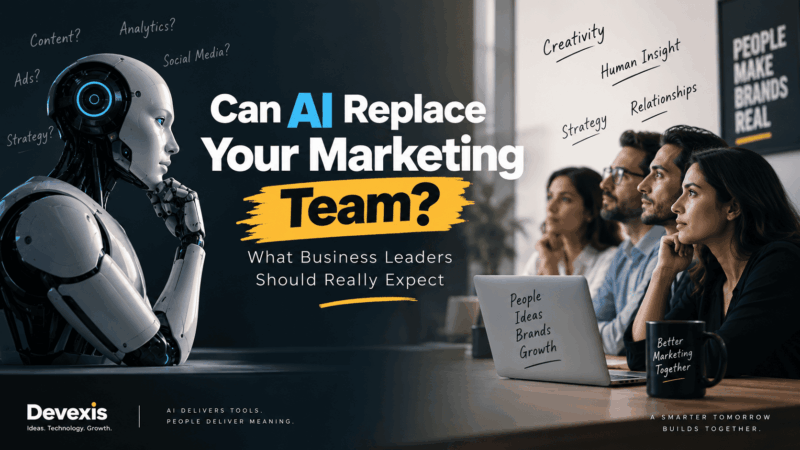
The short answer: not exactly. But it may replace parts of your marketing department—and companies that redesign their teams around that reality could gain a significant advantage.
A marketing team that spends most of its time producing routine content, building repetitive reports, manually segmenting audiences, scheduling campaigns and turning the same idea into ten different formats is vulnerable to automation.
A marketing team that understands customers, shapes positioning, develops differentiated ideas, protects the brand, makes commercial decisions and connects marketing activity to revenue is much harder to replace.
That distinction is becoming increasingly important.
Marketing has entered a new phase where the question is no longer simply “Should we use AI?” The better question for CEOs, founders and marketing leaders is:
Which marketing work should humans continue to own, which work should technology perform, and how should the organization be redesigned around that division of labor?
Research already points toward substantial productivity gains. McKinsey estimates that generative AI could increase marketing-function productivity by the equivalent of 5% to 15% of total marketing spending, while its more recent research argues that the biggest opportunity comes from redesigning entire marketing workflows rather than simply attaching AI tools to existing processes.
Meanwhile, HubSpot’s 2025 research found that AI has moved well beyond experimentation for many marketing organizations, with 91% of marketing leaders saying employees or teams at their organization use AI to assist with their work.
So the real threat isn’t that AI suddenly walks into your office and replaces 12 marketers.
The real threat is that a competitor builds a marketing operation capable of doing the work of 12 people with a smaller, better-designed team—and reinvests the savings into growth.
That is the strategic issue business leaders should be thinking about.
The Reality Check: AI Is Not Replacing “Marketing”
Marketing is not one job.
It is a collection of activities spanning:
- Market research
- Customer research
- Brand strategy
- Positioning
- Product marketing
- Content
- SEO
- Paid advertising
- Social media
- CRM
- Lead generation
- Conversion optimization
- Analytics
- Creative development
- Public relations
- Partnerships
- Customer retention
- Revenue operations
AI can already perform or accelerate many tasks within these functions.
But task automation is not the same as replacing a business function.
Consider the difference.
A system can generate 50 ad variations.
It cannot automatically know which proposition your market should believe.
It can summarize customer reviews.
It cannot necessarily determine which customer problem represents the biggest strategic opportunity.
It can identify keywords.
It cannot decide whether your company should compete for those keywords at all.
It can draft an email.
It cannot take responsibility for whether the campaign strengthens or damages the relationship with a high-value customer.
This is why the most useful question isn’t:
“Can AI replace marketers?”
It is:
“Which parts of marketing should no longer require expensive human hours?”
That question leads to a much more productive business conversation.
What AI Can Replace in a Marketing Team
There are marketing activities where automation is already highly practical.
1. Repetitive Content Production
AI can dramatically accelerate first drafts and variations of:
- Product descriptions
- Social posts
- Ad variations
- Email drafts
- Landing-page variations
- Meta descriptions
- Content briefs
- Video scripts
- Sales enablement material
- FAQ content
- Content repurposing
HubSpot’s marketing research has found that content creation and repurposing are among the common applications of AI, particularly as businesses struggle to keep up with growing content demands.
The implication is not that businesses should publish unlimited machine-produced content.
It is that one strong idea can now become many useful assets much faster.
That changes staffing requirements.
2. Reporting and Data Summarization
Traditional marketing reporting often involves people spending hours collecting numbers from:
- Google Analytics
- Advertising platforms
- CRM systems
- Search Console
- Social platforms
- Email platforms
- eCommerce systems
AI-powered systems can increasingly consolidate information, identify anomalies and produce management summaries.
Instead of asking a marketing analyst:
“What happened last month?”
Leadership can increasingly ask:
“What changed, why did it change, what matters commercially, and what should we do next?”
That is a major shift.
The analyst’s value moves away from assembling information and toward interpreting information and influencing decisions.
3. Audience Segmentation
Traditional segmentation can require substantial manual analysis.
AI can help identify patterns across:
- Purchase behavior
- Website activity
- Customer lifetime value
- Engagement
- Demographics
- Search behavior
- CRM history
- Product usage
- Customer support interactions
This can enable more granular personalization.
McKinsey identifies personalization, customer insights and productivity as major areas where generative AI can reshape marketing and sales.
4. Campaign Variations and Testing
Suppose a company wants to test:
- 10 headlines
- 5 offers
- 4 audiences
- 3 landing-page structures
- 6 creative concepts
That represents thousands of possible combinations.
Humans are not particularly good at manually generating and maintaining all of those variations.
Technology is.
The human role becomes deciding:
What deserves to be tested, what constitutes success, and what should happen after the results arrive?
What AI Will Struggle to Replace
This is where many discussions about AI and marketing become overly simplistic.
Marketing is not merely production.
It is judgment under uncertainty.
1. Strategic Positioning
Your company needs an answer to a deceptively difficult question:
Why should a customer choose you instead of the alternatives?
AI can generate positioning statements.
It cannot automatically guarantee that the positioning is commercially differentiated, credible and defensible.
A software company may have 50 competitors claiming:
- Faster
- Better
- Affordable
- Innovative
- Customer-focused
Generating another version of those claims does not create differentiation.
Someone still has to decide what the company should actually stand for.
2. Deep Customer Understanding
Data can show what customers did.
It doesn’t always explain what they meant.
A founder who has spent years talking to customers may understand an objection that appears nowhere in the CRM.
A sales leader may know why prospects disappear after a proposal.
A healthcare business may understand concerns that customers are reluctant to express publicly.
A manufacturing company may know that purchasing decisions are influenced by operational risk rather than price.
Those insights can be extremely valuable.
The best systems will increasingly combine human knowledge with machine-scale analysis.
They will not eliminate the need for human understanding.
3. Brand Judgment
AI can produce polished language.
That doesn’t mean every piece of polished language should represent your company.
Brands have:
- Personality
- Reputation
- History
- Values
- Market position
- Cultural context
- Customer expectations
A poor automated decision can damage years of brand-building.
Someone must remain accountable for the brand.
4. Original Ideas
AI is excellent at generating possibilities.
But marketing leadership isn’t measured by the number of possibilities generated.
It is measured by selecting the few ideas worth pursuing.
The competitive advantage increasingly shifts from:
“Who can produce the most content?”
to:
“Who can identify the most valuable opportunity and execute it better?”
That is a very different skill.
The New Marketing Team: Human + Technology
The future is unlikely to look like:
Marketing Team → AI → No Humans
It is more likely to look like:
Strategy → Data → Technology → Human Judgment → Execution → Measurement → Learning
This creates what we can call the Augmented Marketing Team.
| Marketing Activity | AI Capability | Human Importance |
|---|---|---|
| Content drafting | Very High | Medium |
| Content repurposing | Very High | Low–Medium |
| Reporting | Very High | Medium |
| Data analysis | High | High |
| Keyword research | High | Medium |
| Ad variations | Very High | Medium |
| Campaign optimization | High | High |
| Customer insight | High | Very High |
| Positioning | Medium | Very High |
| Brand strategy | Medium | Very High |
| Creative direction | Medium–High | Very High |
| Crisis communication | Medium | Very High |
| Pricing strategy | Medium | Very High |
| Market strategy | Medium | Very High |
| Relationship building | Low–Medium | Very High |
| Executive decision-making | Low | Very High |
The lesson is straightforward:
Automate execution where possible. Protect judgment where it matters.
A Better Way to Think About AI: The Marketing Automation Ladder
Not every marketing activity should be automated immediately.
Use this five-level framework.
Level 1 — Assist
Technology helps a person complete the task faster.
Examples:
- Drafting
- Research
- Summarization
- Brainstorming
- Data preparation
Human ownership: High
Level 2 — Accelerate
Technology performs a substantial portion of the work, but a person reviews it.
Examples:
- Content production
- SEO analysis
- Ad variations
- Email personalization
- Reporting
Human ownership: Medium–High
Level 3 — Automate
The process can run with predefined rules and limited intervention.
Examples:
- Lead routing
- Reporting alerts
- Content distribution
- CRM workflows
- Basic customer segmentation
Human ownership: Medium
Level 4 — Optimize
Systems analyze results and continuously improve predefined processes.
Examples:
- Campaign bidding
- Audience optimization
- Conversion testing
- Personalization
- Lead scoring
Human ownership: Strategic
Level 5 — Orchestrate
Multiple systems coordinate actions across the customer journey.
For example:
A visitor arrives → behavior is analyzed → intent is inferred → content is personalized → lead score changes → CRM workflow activates → sales receives context → follow-up occurs → results feed back into the system.
This is where the marketing organization starts behaving less like a collection of campaigns and more like a continuous growth engine.
McKinsey’s 2026 research describes this shift toward AI-enabled marketing workflows and argues that organizations will increasingly need to redesign marketing around continuous insights, scaled creativity, personalization and orchestration rather than simply adding isolated tools.
The Biggest Mistake: Using AI to Do the Old Marketing Faster
This is where many organizations will waste money.
They take an existing process:
Research → Brief → Writer → Designer → Approval → Publishing
and simply insert AI into the middle.
That produces efficiency.
But it doesn’t necessarily produce transformation.
The bigger opportunity is to ask:
If we were designing our marketing operation from scratch today, what would we keep, remove, automate and redesign?
That question can eliminate entire layers of unnecessary work.
A Practical Decision Matrix for Business Leaders
Before automating a marketing task, score it across four dimensions.
| Question | Low Score | High Score |
|---|---|---|
| Is the task repetitive? | Unique | Repetitive |
| Is the output predictable? | Subjective | Predictable |
| Is the cost of an error low? | Dangerous | Low-risk |
| Does the task require human empathy? | High | Low |
Automate aggressively when:
- The task repeats frequently.
- Inputs are structured.
- Outputs are measurable.
- Errors are recoverable.
- Human judgment adds little value.
Keep humans closely involved when:
- Brand reputation is involved.
- Customer relationships are involved.
- Decisions affect revenue materially.
- The situation is ambiguous.
- Ethical considerations matter.
- The cost of being wrong is high.
What This Means for Different Businesses
The impact won’t be identical across industries.
B2B Companies
AI can assist with:
- Account research
- Lead qualification
- Sales intelligence
- Personalized outreach
- Content
- Proposal preparation
- CRM updates
But relationship-building, complex negotiations and enterprise trust remain highly human.
eCommerce
The opportunity is considerably larger.
AI can help with:
- Product descriptions
- Merchandising
- Recommendations
- Customer segmentation
- Ad creative
- Email personalization
- Search
- Customer support
- Conversion testing
- Inventory-related insights
For an eCommerce company, the objective shouldn’t be “replace the marketing department.”
It should be:
Increase revenue per marketing employee while improving customer relevance.
Businesses looking to strengthen the technology underneath this operation may also need a stronger eCommerce development strategy.
Healthcare
Healthcare marketing requires significantly more caution.
Automation can assist with:
- Educational content
- Campaign analysis
- Appointment communication
- Search optimization
- Content distribution
But claims, patient trust, privacy and regulatory considerations require stronger human oversight.
Manufacturing
Manufacturing companies often have complex, technical sales cycles.
AI can support:
- Technical content
- Lead qualification
- Account research
- Distributor communication
- Search visibility
- Sales enablement
But domain expertise remains critical.
Education
AI can accelerate:
- Course marketing
- Lead nurturing
- Content creation
- Student communication
- Campaign personalization
Yet trust, reputation and institutional positioning remain human-led responsibilities.
Real Estate
AI can improve:
- Property content
- Lead qualification
- Follow-up
- Audience targeting
- Listing optimization
- CRM automation
But high-value transactions still depend heavily on relationships and trust.
A Mini Scenario: The 10-Person Marketing Department
Imagine a company with ten marketing employees.
Their workload looks like this:
- 20% reporting
- 20% content production
- 15% social media
- 15% campaign operations
- 10% research
- 10% design variations
- 10% strategy
An organization could automate or accelerate a significant proportion of the first six categories.
But that does not automatically mean it should fire eight people.
Instead, leadership could redesign the team.
The new structure might look like:
2 Strategic Marketing Leaders
Responsible for:
- Positioning
- Growth strategy
- Customer insight
- Budget allocation
- Brand
2 Growth Specialists
Responsible for:
- Performance
- Conversion
- SEO
- Paid acquisition
- Analytics
2 Creative/Brand Specialists
Responsible for:
- Creative direction
- Campaign concepts
- Brand consistency
- High-value content
1 Marketing Operations Specialist
Responsible for:
- CRM
- Automation
- Data
- Integrations
1 Marketing Technology / AI Specialist
Responsible for:
- Workflow design
- Automation
- Systems
- Experimentation
The remaining capacity can be redirected toward growth rather than production.
That is the real opportunity.
The AI Marketing Team of the Future
The marketing department of the future may be smaller in some organizations.
But it may also be more senior, more technical and more commercially accountable.
Expect growing demand for people who can combine:
- Marketing
- Data
- Technology
- Customer psychology
- Business strategy
- Analytics
- Automation
- Creative judgment
The old model rewarded specialists who performed one recurring task extremely well.
The emerging model rewards people who can design systems and make decisions across functions.
That is already visible in the labor market: current reporting points toward changing demand for marketers with stronger AI, analytics, business and strategic capabilities rather than simply more execution capacity.
What Business Leaders Should Do Now
Don’t begin by buying ten AI tools.
Begin by mapping your marketing operation.
Step 1: List Every Recurring Marketing Task
Document everything your team does over a month.
Don’t write:
“SEO.”
Write:
“Review Search Console queries every Monday, identify pages losing impressions, compare competitors, prepare recommendations and assign content updates.”
The second description can be evaluated.
Step 2: Calculate the Human Cost
For every process, estimate:
Frequency × Hours × Cost
You will quickly discover where your marketing budget is being consumed.
Step 3: Classify Each Task
Put every activity into one of four categories:
A — Human-led
Requires strategic judgment.
B — Human + technology
Technology accelerates the work, but humans approve it.
C — Automated
Technology can execute reliably.
D — Eliminate
The activity creates little business value and should disappear.
That fourth category is frequently overlooked.
The best automation is sometimes deleting the task entirely.
The 30-Day Marketing AI Transformation Framework
Week 1: Audit
Map:
- People
- Processes
- Tools
- Data
- Campaigns
- Reporting
- Bottlenecks
Identify the 10 most time-consuming marketing activities.
Week 2: Prioritize
Score each activity on:
Business value × frequency × automation potential
Start with processes that are repetitive, measurable and low-risk.
Week 3: Build
Redesign the highest-value workflows.
Connect:
- Website
- CRM
- Analytics
- Advertising
- Content systems
- Customer data
This is where a strong website development foundation and appropriate CMS development can become strategically important rather than merely technical infrastructure.
Week 4: Measure
Track:
- Cost per lead
- Conversion rate
- Customer acquisition cost
- Revenue per marketing employee
- Content production time
- Campaign cycle time
- Lead response time
- Marketing-qualified leads
- Pipeline contribution
- Revenue contribution
Don’t measure success by the number of tasks automated.
Measure business outcomes.
The New Marketing KPI: Output per Employee Is Not Enough
A dangerous mistake is using AI simply to increase output.
If your team previously produced 20 pieces of content per month and now produces 200, that isn’t automatically a success.
You may simply have created 180 more pieces nobody needs.
The better question is:
Did marketing create more business value with the same or fewer resources?
Measure:
Efficiency
How much time and money does marketing require?
Effectiveness
How well does marketing generate qualified demand?
Quality
Does the output improve customer experience and brand perception?
Growth
Does marketing contribute to revenue?
Learning
Does every campaign make the next decision better?
That final metric becomes particularly important as marketing evolves toward continuous optimization.
Pros and Cons of Replacing Marketing Work With AI
Advantages
- Lower execution costs
- Faster campaign development
- More personalization
- Higher content production capacity
- Faster analysis
- More experimentation
- Better workflow automation
- Reduced repetitive work
- Greater scalability
Risks
- Generic brand communication
- Poor strategic judgment
- Incorrect information
- Loss of brand differentiation
- Privacy and security issues
- Over-automation
- Weak human oversight
- Dependence on third-party systems
- Producing more content without producing more value
The solution isn’t avoiding automation.
It is governing automation intelligently.
What About SEO and AI Search?
This is particularly important for business leaders.
Search is changing from a model where users primarily browse a list of links toward experiences where systems increasingly summarize information, answer questions and help users evaluate options.
Google’s current guidance is remarkably clear: there is no special technical requirement for appearing in AI Overviews or AI Mode beyond being eligible for normal Google Search, and the fundamentals of helpful, reliable, people-first SEO still apply.
Google’s newer guidance for generative AI search emphasizes something even more important:
Create unique, valuable, non-commodity content that offers genuine expertise and a perspective users cannot easily get elsewhere.
That means businesses should not respond to AI search by producing 500 shallow articles.
They should build:
- Original research
- Expert analysis
- First-hand insights
- Strong service pages
- Detailed comparisons
- Real examples
- Useful frameworks
- Clear answers
- Strong entity relationships
- Trust signals
- Well-structured information
In other words:
The future of SEO is not less expertise. It is more expertise, presented more usefully.
For companies investing in organic growth, a disciplined SEO and social media strategy remains foundational.
Paid acquisition and social distribution can then complement organic growth through a coordinated SEM and SMM strategy.
Future Trend: Marketing Becomes a Continuous System
The biggest change may not be content generation.
It may be the transition from campaign-based marketing to continuous marketing.
The old model:
Plan → Launch → Wait → Analyze → Report
The emerging model:
Detect → Decide → Create → Personalize → Launch → Measure → Learn → Adjust → Repeat
This is fundamentally different.
Marketing becomes a living system.
Customer signals continuously influence:
- Content
- Offers
- Advertising
- Website experiences
- Sales priorities
- Product messaging
McKinsey’s 2026 research describes this broader shift as marketing becoming a real-time growth engine integrating insights, content, commerce and performance rather than operating as disconnected campaigns.
That is where technology becomes genuinely strategic.
The Executive Decision Tree
Ask these five questions about every marketing activity:
1. Is it repetitive?
No → Keep human ownership.
Yes → Continue.
2. Can success be measured objectively?
No → Keep meaningful human oversight.
Yes → Continue.
3. Is the process low-risk?
No → Use human approval.
Yes → Continue.
4. Does the activity require empathy, judgment or strategic context?
Yes → Augment the human rather than replacing them.
No → Continue.
5. Can the workflow be reliably automated?
Yes → Automate it.
No → Keep a human in the loop and improve the process first.
This simple framework can prevent expensive automation mistakes.
What Should Business Leaders Expect From Their Marketing Team?
Don’t expect:
“AI will do everything.”
Expect:
Smaller amounts of manual execution.
Faster campaign cycles.
More experimentation.
Greater personalization.
More data-driven decisions.
Fewer hours spent producing routine assets.
More pressure on marketers to understand technology.
More accountability for revenue.
More cross-functional collaboration.
And potentially:
Fewer traditional marketing roles—but stronger strategic roles.
That distinction matters.
The Bottom Line
Can AI replace your marketing team?
It can replace parts of the work your marketing team currently performs.
It can automate repetitive execution.
It can reduce the amount of manual analysis.
It can accelerate content and creative production.
It can personalize customer experiences at a scale humans cannot.
It can coordinate increasingly complex workflows.
But the companies that benefit most won’t simply ask:
“How many marketers can we replace?”
They will ask:
“How much more growth can our marketing organization generate when people spend less time on repetitive work and more time on high-value decisions?”
That is the better question.
Because the competitive advantage of the next few years may not belong to companies with the biggest marketing departments.
It may belong to companies with the best-designed marketing systems.
The winners will combine technology’s speed and scale with human judgment, customer understanding, creativity, accountability and strategic thinking.
AI won’t make marketing irrelevant. It will make inefficient marketing harder to justify.
A Practical Checklist for CEOs and Marketing Leaders
Before making major changes to your marketing team, ask:
- Have we mapped every recurring marketing workflow?
- Do we know how much each process costs?
- Which tasks are genuinely repetitive?
- Which tasks require human judgment?
- Which activities can be eliminated entirely?
- Is our CRM connected to marketing data?
- Can our website support automated customer journeys?
- Are we measuring revenue, not just traffic and engagement?
- Are we using automation to improve customer experience?
- Do we have clear approval rules for high-risk activity?
- Are our marketing systems connected?
- Are we investing in strategic marketing skills?
- Are we testing automation against measurable business outcomes?
- Are we creating genuinely differentiated content?
- Can customers find and understand our expertise across search and AI-driven discovery?
If most answers are no, the first opportunity may not be replacing your marketing team.
It may be redesigning the marketing operation.
Key Takeaways
- AI is more likely to replace marketing tasks than entire marketing teams.
- Repetitive, predictable and measurable marketing work is the easiest to automate.
- Strategy, positioning, customer understanding, brand judgment and accountability remain highly valuable human responsibilities.
- The biggest opportunity is redesigning workflows—not simply adding AI tools to old processes.
- Marketing teams may become smaller, more technical and more commercially accountable.
- Businesses should measure automation by revenue and business outcomes, not the number of tasks automated.
- AI Search increases the value of original expertise, useful structure and genuinely differentiated information.
- The future is moving from campaign-based marketing toward continuous, technology-enabled growth systems.
- The smartest companies will use technology to remove low-value work and reinvest human capacity into high-value decisions.
- The goal isn’t to build an AI marketing department. It is to build a better marketing organization.
Need Help Redesigning Your Marketing Operation?
Technology creates the most value when it is connected to a business strategy.
If your organization is evaluating AI automation, digital transformation, marketing technology, website performance, SEO, eCommerce or customer acquisition, the right starting point is not necessarily another software subscription.
It is understanding where technology can remove friction, improve decisions and create measurable growth.
Devexis India works with startups, SMEs, enterprises and founders across technology, digital marketing, automation, websites, eCommerce and digital transformation.
If your current marketing operation feels too manual, too fragmented or too expensive to scale, let’s examine the system—not just the tools.
Frequently Asked Questions
1. Can AI replace a marketing team?
AI can replace or automate many marketing tasks, but completely replacing a capable marketing team is unlikely for most businesses. AI is strongest at repetitive, data-heavy and scalable activities, while strategy, positioning, customer understanding, brand judgment and commercial decision-making still require significant human involvement.
2. Will AI replace digital marketing jobs?
AI is likely to change many digital marketing jobs. Roles focused heavily on repetitive execution may shrink, while demand can increase for marketers who understand strategy, analytics, technology, automation, customer behavior and business outcomes.
3. What marketing tasks can AI automate?
Common candidates include content drafting, content repurposing, reporting, audience segmentation, lead scoring, campaign variations, data analysis, personalization, email workflows, keyword research and parts of advertising optimization.
4. What marketing tasks should humans keep doing?
Humans should remain closely involved in strategy, positioning, brand management, complex customer relationships, high-stakes communication, creative direction, business judgment and decisions where errors could significantly affect revenue or reputation.
5. Will AI make marketing teams smaller?
In some organizations, yes. AI can increase the amount of work a smaller team can handle. However, the strategic outcome should not automatically be staff reduction. Businesses can also use productivity gains to increase experimentation, improve customer experience and pursue new growth opportunities.
6. Is AI-generated content good for SEO?
AI-assisted content can perform in search when it is accurate, useful, original and genuinely valuable to users. Google states that its systems focus on content quality rather than giving an inherent ranking advantage to content simply because or because it wasn’t produced using a particular method. Google’s current guidance emphasizes helpful, reliable, people-first content and warns against scaled content created primarily to manipulate rankings.
7. How should businesses prepare for AI in marketing?
Start by auditing marketing workflows. Identify repetitive processes, calculate their cost, determine which activities can be automated safely, connect relevant systems and establish measurable business KPIs. Then redesign roles around strategy, customer insight, technology and growth rather than simply adding more tools.
8. Will AI replace SEO professionals?
AI will automate portions of SEO, including research, analysis, reporting and content workflows. But technical judgment, search strategy, information architecture, business understanding, authority building and prioritization remain important. SEO professionals who learn to work with increasingly automated systems are likely to become more valuable than those focused primarily on manual execution.
9. Should a small business replace its marketing agency with AI?
Not automatically. A small business should compare the agency’s actual contribution against what technology can reliably automate internally. If an agency mainly provides repetitive production, automation may reduce the need for that service. If it provides strategy, positioning, expertise, creative direction and measurable growth, replacing it solely with software could create more risk than savings.
10. What is the future of AI-powered marketing?
The future is moving toward continuous marketing systems that combine customer data, content, personalization, automation, analytics and human decision-making. Instead of running isolated campaigns and analyzing them afterward, businesses will increasingly build systems that continuously detect signals, make decisions, execute actions and learn from outcomes.